
A fireplace or wood heater in a new South Australian house is covered by two sets of rules. The NCC 2022 deals with the building: Performance Requirement H7P3 and, as Deemed-to-Satisfy routes, AS/NZS 2918 or Part 12.4 of the Housing Provisions, which sets hearths, clearances and flue heights. South Australia’s Environment Protection (Air Quality) Policy 2016 deals with the heater: which solid fuel heaters may be sold and installed, and excessive smoke. The NCC’s explanatory information states that H7P3 “is not intended to apply to inserted fireplaces fuelled by gas”, and the Air Quality Policy’s heater clauses deal with solid fuel heaters; gas fitting is administered by the Office of the Technical Regulator. This note quotes NCC 2022. The ABCB records that NCC 2025 was published on 1 May 2026, and lists South Australia as “BCA: 1 May 2027” and “PCA: 1 May 2026”. Which edition applies to a particular application is for the relevant authority assessing the building work to confirm.
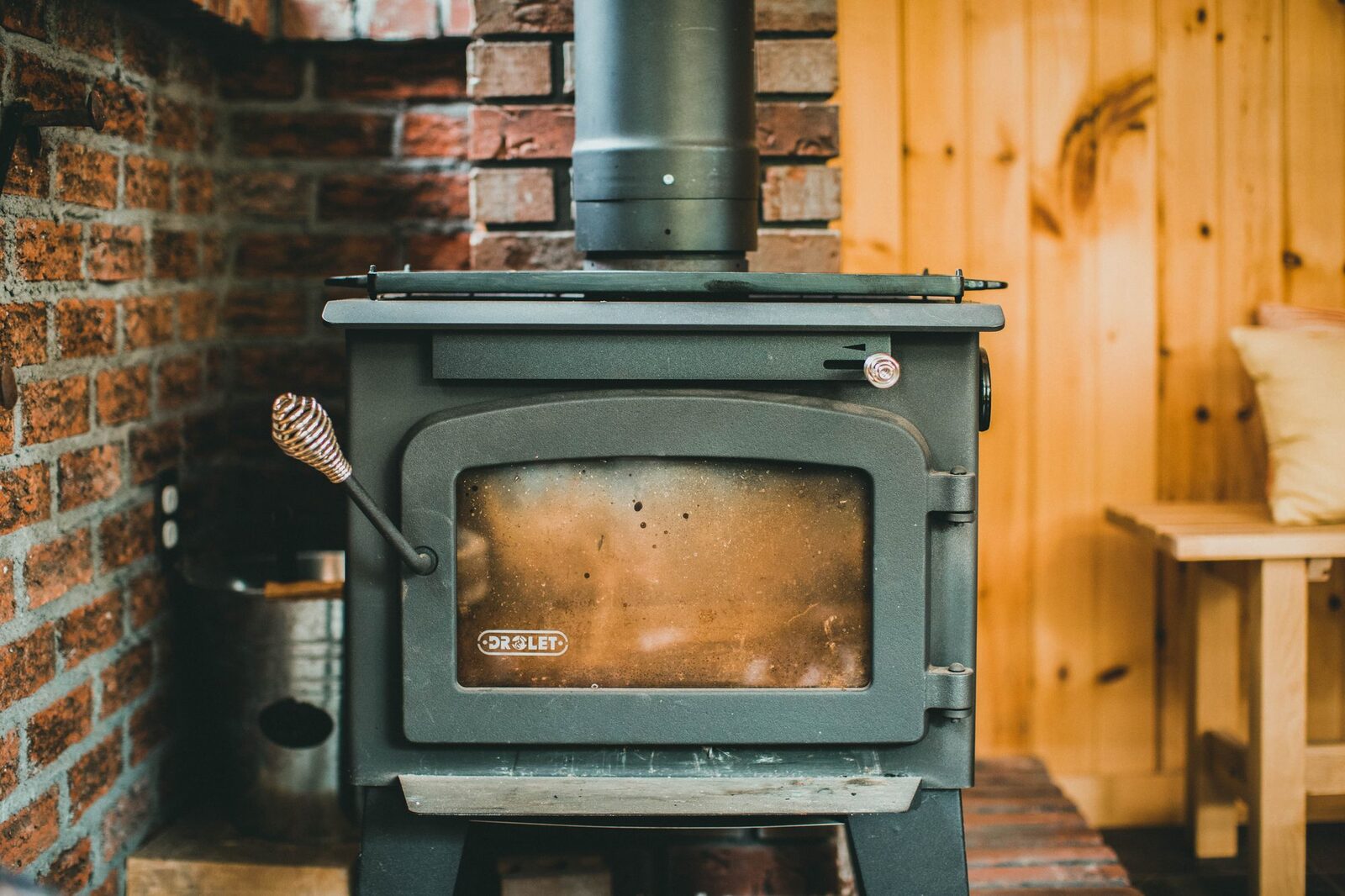
Which NCC rules apply to a fireplace or wood heater?
Volume Two Performance Requirement H7P3 states that “A heating appliance and its associated components within a building, including an open fire-place, chimney, or the like, must be installed—” to withstand the temperatures likely to be generated by the appliance; so that it does not raise the temperature of any building element to a level that would adversely affect the element’s properties or function; and “so that hot products of combustion will not—” escape through the walls of the associated components. H7P3(c)(ii) states that combustion products must not discharge where they will spread fire to nearby combustible materials or allow smoke through nearby windows, ventilation inlets or similar openings in the building containing the heating appliance.
Clause H7D5 states that H7P3 is satisfied for a heating appliance if it is installed in accordance with “(a) for a domestic solid fuel burning appliance, AS/NZS 2918; or (b) for a heating appliance, Part 12.4 of the ABCB Housing Provisions.” Those are Deemed-to-Satisfy routes; under clause A2G1(2), a Performance Solution, or a combination of the two, is the other way of meeting H7P3.
The explanatory information to H7D5 names three types: open fireplaces, “where solid fuel such as timber or coals are burnt in an unenclosed compartment”; insert fireplaces, “manufactured and assembled in factories and inserted into the openings of masonry fireplaces”; and free standing heating appliances, “installed in the building without being concealed by wall or floor elements.”
No South Australian variation to H7P3, H7D5 or Part 12.4 was found. South Australia’s Volume Two Part H7 variations deal with swimming pools and bushfire construction, and its Housing Provisions variations are to Parts 4.2, 9.2, 10.2 and 13.1.
What does the NCC say about an open fireplace and chimney?
Clause 12.4.2 requires an open fireplace to have masonry built in accordance with H1D5, and a hearth “of stone, concrete, masonry or similar non-combustible material” that extends “not less than 300 mm beyond the front of the fireplace opening and not less than 150 mm beyond each side of that opening”, with its upper surface not sloping away from the back hearth, and with combustible material such as flooring or framing “situated not less than 150 mm from the upper surface of the hearth”. The sides and back, up to 300 mm above the underside of the arch or lintel, are to be two separate leaves of solid masonry “with a total combined thickness not less than 180 mm, excluding any cavity”, without concrete block masonry in the inner leaf, and built of masonry units “with a net volume, excluding cored and similar holes, not less than 75% of their gross volume” and an actual thickness of not less than 100 mm. The fireplace is to sit on footings complying with 4.2.18.
Clause 12.4.3 requires chimney walls above that level to be “lined internally to a thickness of not less than 10 mm with composition mortar parging”, and states: “The chimney or flue must terminate not less than 300 mm above the highest part of the building within a horizontal distance of 3.6 m of the chimney or flue”.
Where Part 13.4 applies, NCC 2022 Housing Provisions clause 13.4.2 provides the Deemed-to-Satisfy requirement for a closable damper or flap on an open solid-fuel appliance’s chimney or flue: “The chimney or flue of an open solid-fuel burning appliance must be provided with a damper or flap that can be closed to seal the chimney or flue.” National clause 13.4.1(2)(a) excludes buildings in climate zones 1, 2, 3 and 5 whose only air-conditioning is evaporative cooling, and clause 13.4.1(3) directs application through H6D2(1)(a) or (b). The explanatory information to 13.4.2 adds that the clause “does not apply to gas and liquid fuel burning appliances.” South Australia’s energy provisions must also be checked against the applicable MBS 007; this note has not verified its current text, and the relevant authority assessing the building work should confirm the provisions applicable to the application.
How far does a wood heater need to be from a wall?
For a free-standing heating appliance, clause 12.4.5(a) gives three options. The appliance must be “installed with safety clearances determined by testing in accordance with AS/NZS 2918”; or “located not less than 1.2 m from adjoining walls (other than a masonry wall)”; or have a heat shield between the adjoining non-masonry wall and the appliance, in accordance with Figures 12.4.5a and 12.4.5b.
A heat shield is to have “an FRL of not less than 60/60/60” or be “not less than 90 mm thick masonry constructed in accordance with H1D5”. The appliance sits on a hearth complying with 12.4.2(b), “except that the hearth must extend 400 mm from the front and sides of the appliance”, or, with a heat shield, in accordance with the figures. The flue must have passed the tests required by AS/NZS 2918, be installed in accordance with Figure 12.4.5c, terminate in accordance with Figure 12.4.3 and be flashed in accordance with H1D7. A note to Figure 12.4.5c reads “Flue pipe size — 150 mm maximum (for other sizes see AS/NZS 2918).”
For an insert fireplace, clause 12.4.4 requires the insert and flue to have passed the AS/NZS 2918 tests and to be fitted into a masonry fireplace built in accordance with H1D5, with a double skin flue, “a clearance of 50 mm between the outer flue and adjacent materials”, termination in accordance with Figure 12.4.3 and a hearth in accordance with 12.4.2(b) and (d).
What do South Australia’s air quality rules say about wood heaters?
The EPA states that the Environment Protection (Air Quality) Policy 2016 “regulates the sale, installation and operation of solid fuel heaters”. The Policy defines a solid fuel heater as “any solid fuel burning appliance that is designed, manufactured or adapted for use in domestic premises (whether or not it is actually used in such premises)”.
Clause 10(1) states: “A person must not install a solid fuel heater unless the heater is marked as being compliant with AS/NZS 4012:2014 and AS/NZS 4013:2014.” Clause 10(2) requires a person installing one to “comply with any mandatory measures of AS/NZS 2918:2001, AS/NZS 4012:2014 and AS/NZS 4013:2014 that apply in relation to the installation of solid fuel heaters of that kind”, and clause 10(3) requires them to “have regard to any recommended measures” of the same Standards. Clause 10(4) allows the Authority to apply an overseas standard it is satisfied is “equivalent to, or more stringent than” a listed Standard. Clause 9 sets matching conditions on sale, including that a certificate of compliance exists for the heater.
Clause 12(1) states that the owner or occupier of premises where a solid fuel heater is used “must not cause or permit excessive smoke to be emitted to the air from the heater.” Clause 12(2) expressly does not limit the circumstances in which smoke may be excessive; it specifies that smoke is taken to be excessive where a visible plume continues for at least 10 minutes, including at least 30 seconds extending at least 10 metres from its emission point at the flue or chimney.
The Policy names the 2001 edition of AS/NZS 2918; the NCC 2022 referenced documents list the 2018 edition, with a note that test reports based on the 2001 edition issued before the 2018 edition was referenced remain valid. This note does not reproduce either Standard.
How high does a wood heater flue need to be?
Under the Part 12.4 Deemed-to-Satisfy route, clause 12.4.3(c) states that the chimney or flue “must terminate not less than 300 mm above the highest part of the building within a horizontal distance of 3.6 m of the chimney or flue”, and clauses 12.4.4(d) and 12.4.5(d)(iii) apply the same Figure 12.4.3 to insert and free-standing heaters. Clause 12.4.5(e) adds: “Flue types or installation of flues in areas not specifically covered by Figure 12.4.5a and Figure 12.4.5b and Figure 12.4.5c must be installed in accordance with AS/NZS 2918.” Clause H7D5(a) lists AS/NZS 2918 as another Deemed-to-Satisfy route for a domestic solid fuel burning appliance; this note does not reproduce that Standard.
The EPA goes further as a recommendation rather than a rule: it “recommends that the flue be 1 metre higher than the ridge line of the roof and any structure within 15 metres to minimise the potential risk of causing wood smoke and odour nuisance.” It explains that if the flue is lower than the ridgeline, “the smoke can be caught up in the downwash or turbulence on the lee side of the building and can directly enter the house or a neighbour’s property.” The EPA also states: “The SA Government does not have any plans to ban solid fuel heaters, however they are not recommended in high density living, metropolitan areas as the smoke may impact on neighbours.”
Who can install a wood heater in South Australia?
The sources read for this note do not set out a specific licence class for installing a solid fuel heater. Clause 10 of the Air Quality Policy applies to “A person” installing one. The EPA’s advice states: “Installation should be conducted by a qualified tradesperson, according to manufacturer’s instructions and in accordance with AS/NZS 2918: 2001 Domestic solid fuel burning appliances – Installation.”
The EPA also states: “Check with your local council before installing your solid fuel heater as it may require approval under building codes.” On the heater itself, it notes that compliant heaters display “THIS HEATER COMPLIES WITH AS/NZS 4012:2014 AND AS/NZS 4013:2014 on a plate on the back of the heater.”
What rules apply to a gas fireplace?
The explanatory information to H7P3 states: “H7P3 is not intended to apply to inserted fireplaces fuelled by gas. Insert gas fireplaces may be regulated by relevant authorities responsible for gas installations in each State or Territory jurisdiction and may be required to comply with AS/NZS 5601 – Gas installations.” The explanatory information to H7D5 adds that insert gas fireplaces “are not covered by Part 12.4”.
In South Australia, the NCC’s list of other legislation names the Office of the Technical Regulator for gas installations, under the Gas Act 1997 and Gas Regulations 2012. The OTR’s gas trades page states that “Gas fitters must issue an eCoC to customers after completing any gas installation work” and that “Only people with an appropriate licence can legally fill out an eCoC and certify work.” The work it lists includes “installing new, pre-owned or replacement gas appliances”, “installing new or replacement gas appliance flue pipes” and “commissioning appliances”. It also states: “All gas appliances must be certified before they can be sold or installed in South Australia.”
Do you need building consent for a fireplace or gas heater?
Schedule 4 of the Planning, Development and Infrastructure (General) Regulations 2017 lists acts declared not to be development. Clause 4(5)(b), other than in respect of a local heritage place, lists “the installation or alteration of a building or the making of any excavation or filling, that is necessary for or incidental to the installation of, any electrical, gas, water, sewage and sullage, or telecommunications service (including appliances and fittings), and which does not affect the ability of the building in which it is installed to resist the spread of fire”. Schedule 4 clause 4(4), other than in respect of a local heritage place, lists repair, maintenance or internal alteration that involves no demolition other than removal of fixtures, fittings or non load-bearing partitions, will not adversely affect the building’s structural soundness or occupants’ health or safety, and is not inconsistent with another provision of the Schedule.
Regulation 3C limits these exclusions. Among other limits, they do not apply in respect of a State heritage place (3C(3)), or “in respect of any work involving any repair to, or alteration or restoration of, a building that would cause the building not to comply with the Building Rules” (3C(4)). Whether a particular fireplace, heater or flue falls within an exclusion, or forms part of the building work needing consent, is for the council or relevant authority to confirm for the address. For a new house, the heating shown in the drawings is one of the details to settle with the designer before documents are lodged.
Common Questions
What are the wood heater installation requirements in South Australia?
Under NCC 2022 Volume Two clause H7D5, a solid fuel heater meets Performance Requirement H7P3 if installed in accordance with AS/NZS 2918 or Part 12.4 of the Housing Provisions, which sets hearths, clearances and flue termination; a Performance Solution is the other route. Separately, clause 10 of South Australia’s Environment Protection (Air Quality) Policy 2016 states that “A person must not install a solid fuel heater unless the heater is marked as being compliant with AS/NZS 4012:2014 and AS/NZS 4013:2014”, and requires installers to comply with the mandatory installation measures of AS/NZS 2918:2001 and those Standards; clause 10(4) allows the Authority to apply an equivalent or more stringent overseas standard.
Who can install a wood heater in SA?
The South Australian sources read for this note, the Environment Protection (Air Quality) Policy 2016 and the EPA’s domestic heating page, do not name a specific licence class for installing a solid fuel heater. The EPA states: “Installation should be conducted by a qualified tradesperson, according to manufacturer’s instructions and in accordance with AS/NZS 2918: 2001”, and “Check with your local council before installing your solid fuel heater as it may require approval under building codes.” Gas appliances are different: the OTR states that only people with an appropriate licence can fill out a gas eCoC.
Do I need building consent for a gas fireplace in SA?
Whether a particular gas fireplace installation needs consent is for the council or relevant authority to confirm for the address. Schedule 4 clause 4(5)(b) of South Australia’s Planning, Development and Infrastructure (General) Regulations 2017 excludes from development, “Other than in respect of a local heritage place”, building work “necessary for or incidental to the installation of” a gas service “(including appliances and fittings)” that “does not affect the ability of the building in which it is installed to resist the spread of fire”. Regulation 3C limits these exclusions. Among other limits, they do not apply in respect of a State heritage place (3C(3)), or “in respect of any work involving any repair to, or alteration or restoration of, a building that would cause the building not to comply with the Building Rules” (3C(4)). Separately, the OTR requires a gas fitter to issue an eCoC for gas installation work.
How high does a wood heater flue need to be above the roof?
Under the Part 12.4 Deemed-to-Satisfy route in the NCC 2022 Housing Provisions, clause 12.4.3(c) states that a chimney or flue “must terminate not less than 300 mm above the highest part of the building within a horizontal distance of 3.6 m of the chimney or flue”, and clause 12.4.5(e) sends flues in areas not covered by Figures 12.4.5a to 12.4.5c to AS/NZS 2918. Clause H7D5(a) of Volume Two lists AS/NZS 2918 as another Deemed-to-Satisfy route for a domestic solid fuel burning appliance. The South Australian EPA, as a recommendation, “recommends that the flue be 1 metre higher than the ridge line of the roof and any structure within 15 metres to minimise the potential risk of causing wood smoke and odour nuisance.”
How far must a free-standing wood heater be from a wall?
Clause 12.4.5(a) of the NCC 2022 Housing Provisions, a Deemed-to-Satisfy Provision, gives three options for a free-standing heating appliance: safety clearances determined by testing in accordance with AS/NZS 2918; not less than 1.2 m from adjoining walls other than a masonry wall; or a heat shield, which must have an FRL of not less than 60/60/60 or be not less than 90 mm thick masonry constructed in accordance with H1D5, installed in accordance with Figures 12.4.5a and 12.4.5b. Under clause 12.4.5(c), the hearth either complies with 12.4.2(b) “except that the hearth must extend 400 mm from the front and sides of the appliance”, or, where a heat shield is installed, follows those figures.
Does an open fireplace need a damper?
Where Part 13.4 applies, NCC 2022 Housing Provisions clause 13.4.2 provides the Deemed-to-Satisfy requirement for a closable damper or flap on an open solid-fuel appliance’s chimney or flue; national clause 13.4.1(2)(a) excludes buildings in climate zones 1, 2, 3 and 5 whose only air-conditioning is evaporative cooling, and clause 13.4.1(3) directs application through H6D2(1)(a) or (b). Its explanatory information says the clause does not apply to gas and liquid fuel burning appliances. South Australia’s energy provisions must also be checked against the applicable MBS 007; this note has not verified its current text, and the relevant authority assessing the building work should confirm the provisions applicable to the application.
Sources
- NCC 2022 Volume Two — Part H7 Ancillary provisions (H7F2, H7P3, H7D5 and explanatory information)Accessed 2026-11-23
- NCC 2022, ABCB Housing Provisions — Part 12.4 Heating appliances, fireplaces, chimneys and fluesAccessed 2026-11-23
- NCC 2022, ABCB Housing Provisions — Part 13.4 Building sealing (clause 13.4.2)Accessed 2026-11-23
- NCC 2022 Volume Two — Part A2 Compliance with the NCC (A2G1)Accessed 2026-11-23
- NCC 2022 Volume Two — Schedule 2 Referenced documents (AS/NZS 2918 and Note 8)Accessed 2026-11-23
- NCC 2022 Volume Two — Schedule 8 South Australia, Part H7 Ancillary provisionsAccessed 2026-11-23
- NCC 2022 Volume Two — Schedule 8 South Australia, Other legislation affecting buildingsAccessed 2026-11-23
- Environment Protection (Air Quality) Policy 2016 (SA), version 18.5.2023 — clauses 3, 9 to 12 (unofficial version published on legislation.sa.gov.au)Accessed 2026-11-23
- EPA South Australia — Smoke from domestic heatingAccessed 2026-11-23
- Office of the Technical Regulator (SA) — Gas trades (Electronic Certificate of Compliance, appliance certification)Accessed 2026-11-23
- Planning, Development and Infrastructure (General) Regulations 2017 (SA), version 29.10.2026 — regulation 3C and Schedule 4 clause 4Accessed 2026-11-23
- ABCB — NCC 2025 state and territory adoption informationAccessed 2026-11-23
This page describes these sources as they stood on the access dates above. It is not legal advice about any particular property.
Planning a rebuild or new build in Adelaide? Start with a free initial consultation.