
In South Australia, a swimming pool with a water depth of more than 300 mm needs a safety barrier. The PlanSA brochure “Is your swimming pool kid safe?” (March 2021) summarises the fence as “not less than 1.2 metres high”, or 1.8 metres where a boundary fence forms part of the barrier. NCC 2022 Volume Two Performance Requirement H7P1 requires a barrier that restricts young children’s access to the pool, and its Deemed-to-Satisfy clause H7D2 calls up AS 1926.1 and AS 1926.2. State regulations add a deadline: the barrier must be finished before the pool is filled, or within two months of completing the pool, whichever is first. This note quotes NCC 2022.
When does a pool need a safety barrier in SA?
NCC 2022 Volume Two clause H7P1 states: “A barrier must be provided to a swimming pool and must— be continuous for the full extent of the hazard; and be of a strength and rigidity to withstand the foreseeable impact of people; and restrict the access of young children to the pool and the immediate pool surrounds; and have any gates and doors fitted with latching devices not readily operated by young children, and constructed to automatically close and latch.” Its application statement says: “H7P1 only applies to a swimming pool with a depth of water more than 300 mm.”
The NCC glossary defines a swimming pool as one “principally used, or that is designed, manufactured or adapted to be principally used for swimming, wading, paddling, or the like, including a bathing or wading pool, or spa.” The Planning, Development and Infrastructure Act 2016 defines it similarly and includes a “spa pool (but not a spa bath)”.
The Planning, Development and Infrastructure (Swimming Pool Safety) Regulations 2019 list the prescribed swimming pool safety features as “fences”, “barriers”, “water recirculation systems”, “secondary outlets from a swimming pool” and “warning notices”, insofar as they are relevant under the Building Code. Regulation 6(1a) requires the owner to ensure they are “installed and maintained”.
How high does a pool fence need to be in SA?
The NCC route for a new pool is clause H7D2(1): H7P1 is satisfied for a pool with a depth of water more than 300 mm associated with a Class 1 building “if it has safety barriers installed in accordance with AS 1926.1 and AS 1926.2.” This note does not reproduce those Standards.
The PlanSA brochure “Is your swimming pool kid safe?”, dated March 2021, summarises barrier requirements complying with AS 1926.1. It says fencing must be constructed so that “the fence is an effective barrier to young children”, “it is permanent”, “it does not provide access for young children to crawl under or to climb over by using foot and hand holds”, and “it is not less than 1.2 metres high”. Its diagram adds: “Any type of fence is OK, provided there are no gaps larger than 100mm, and it is not ‘climbable’”.
The brochure is dated March 2021, before NCC 2022 was adopted, and is a summary; NCC 2022 Volume Two Schedule 2 lists AS 1926.1—2012 and AS 1926.2—2007 for H7D2. Which edition applies to a particular application is for the relevant authority to confirm.
Can a boundary fence be part of the pool barrier?
The PlanSA brochure says boundary fences used as part of the child-safety barrier “must be at least 1.8 metres high on the inside, with a 900mm non-climbable zone on the inside at the top. It can be less than 1.8 metres high and can be climbable on the outside (neighbour’s side).”
A pool safety fence is treated differently from an ordinary fence for approval. Schedule 4 clause 4(1)(d) of the Planning, Development and Infrastructure (General) Regulations 2017 excludes from the definition of development a fence not exceeding 2.1 m in height, other than, among others, “a fence that is (or is to be) a safety fence for a swimming pool or spa pool which is approved for construction, or requires approval for construction, on or after 1 July 1993”. Where the barrier is also a dividing fence, the Fences Act process with the neighbour is covered in a separate note.
What are the rules for pool gates, doors and windows?
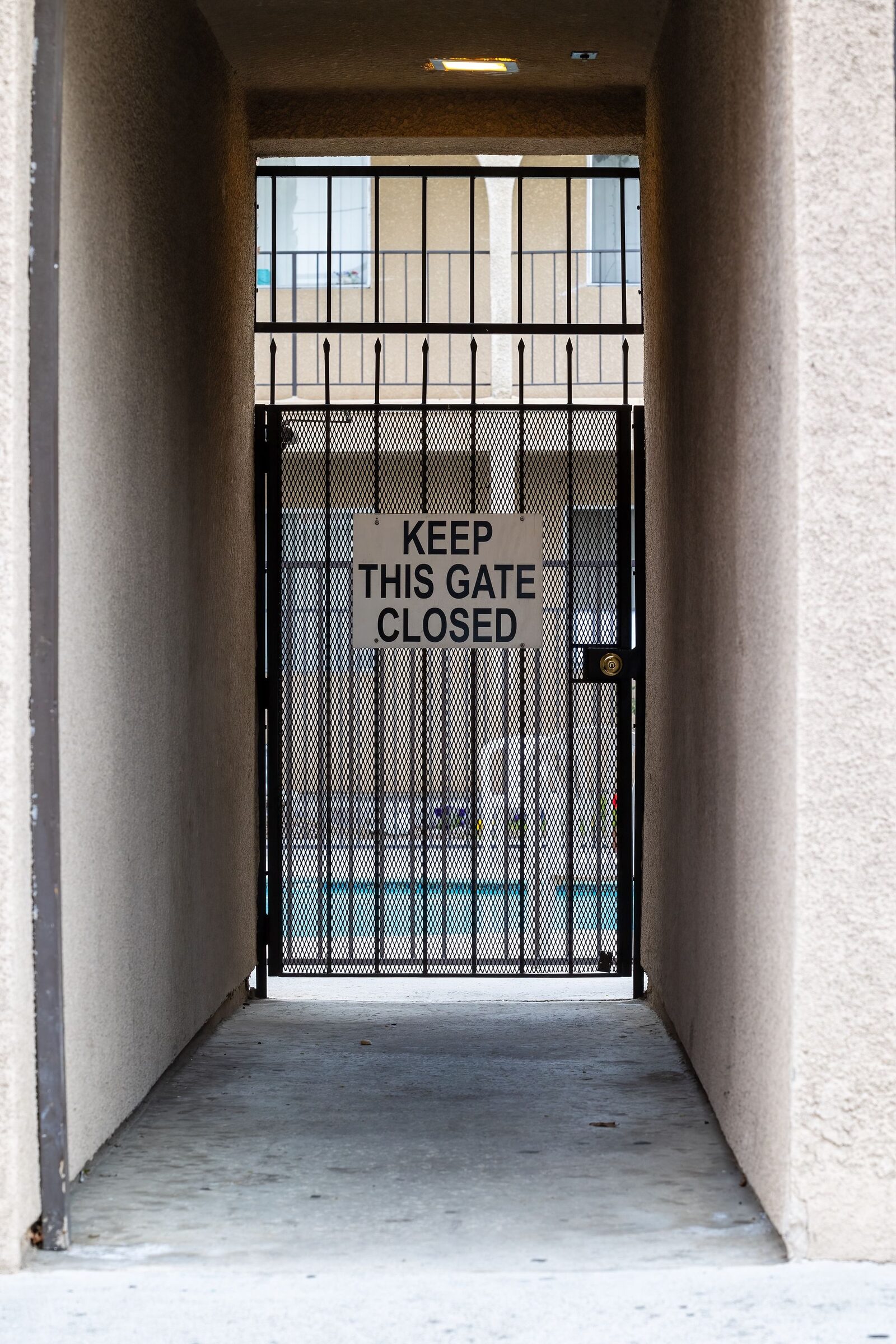
H7P1 requires gates and doors to have “latching devices not readily operated by young children” and to be “constructed to automatically close and latch.” The PlanSA brochure says gates to the pool area must “only swing outward from the pool area”, “be self closing from any position”, and be fitted with a latching device “out reach of small children (generally 1.5 metres above ground level)”.
On doors, the brochure states: “Child-resistant doors cannot be used for new outdoor pools – only compliant fencing can be used.” On windows, it says that where the openable part of a window “is less than 1.8 metres above the finished ground level and provides direct access from the house to the pool area”, it must have “bars or metal screen” or “a mechanism limiting the size of the window opening to a maximum of 100mm.”
What else does South Australia add to the NCC?
Both South Australian schedules were checked. South Australia does not vary H7D2(1); its variations insert subclauses (3) to (5). The Housing Provisions schedule lists variations to Parts 4.2, 9.2, 10.2 and 13.1, none about pool barriers. The Volume Two schedule adds SA H7P1(2): “A swimming pool must have prominent and visible signage that assists persons to provide first-aid and to perform cardiopulmonary resuscitation on young children.”
SA H7D2(5) says the sign must “be attached to the safety barrier of the swimming pool or be displayed near the swimming pool”, “be at least 300 mm by 300 mm in size”, “be made of durable and weatherproof material”, and “show information about the procedures for providing first aid, including performing cardiopulmonary resuscitation.” SA H7D2(3) treats a skimmer box as an outlet that “must have a means of releasing the vacuum pressure should the suction become blocked”, alongside H7D2(2), which calls up AS 1926.3 for water recirculation systems.
The ABCB records that NCC 2025 was published on 1 May 2026, and lists South Australia as “BCA: 1 May 2027” and “PCA: 1 May 2026”. Which edition applies to a particular application is for the relevant authority to confirm.
Does a new pool or spa need approval, and when must the fence be finished?
The PlanSA brochure answers “Do I need development approval for a new pool?” with “Yes”, and says “your local council will check” the safety barriers, the safety of the pump and structural support (the brochure’s wording; for building rules consent the relevant authority may be a building certifier). The General Regulations set out exclusions: Schedule 4 clause 4(1)(c) excludes from the definition of development, other than in respect of a local heritage place and other than in a designated flood zone, subzone or overlay or another area identified under the Planning and Design Code, a swimming pool or spa pool built with a dwelling for its occupants that “does not have a depth exceeding 300 mm” or, for an aboveground or inflatable pool or spa, “does not incorporate a filtration system”. Other conditions in the Regulations also apply, and State heritage areas are dealt with under Schedule 5. Regulation 3G makes an aboveground or inflatable pool that can be filled deeper than 300 mm building work, with limited exceptions. Whether a particular pool or spa needs approval is for the relevant authority to confirm.
An application for building consent involving a pool or a pool safety fence must include details of them, and for a new pool a plan showing “the dimensions of the swimming pool and swimming pool safety features”, under Schedule 8 clause 4(1)(g). Regulation 104(2) applies the Statement of Compliance to a swimming pool even though it is a Class 10 building.
On timing, regulation 7 of the Swimming Pool Safety Regulations requires the licensed building work contractor (or, if none, the owner) to complete the designated safety features by the earlier of “the date that falls 2 months after completion of the construction of the swimming pool” and “the date on which the pool is filled with water.” Under regulation 4(2), for a pool constructed after that subregulation commenced on 4 March 2021, temporary fencing is not regarded as a compliant designated safety feature once two months have passed from completion of the pool, “except as provided in subregulation (3)”. Regulation 4(3) covers a pool fence being maintained or repaired: the owner must ensure temporary fencing that satisfies the requirements is installed and maintained for that period. The brochure says: “You must not fill the pool until a complying safety barrier is in place.” Practice Direction 8 (version 6, 19 June 2025, the version read) requires councils to inspect pool safety features within 10 business days in Metropolitan Adelaide, and 15 business days outside it, of being notified of the completion of the pool or its safety features, or of a temporary safety barrier being installed for a pool with a water depth greater than 300 mm.
What happens when a house with a pool is sold?
Regulation 5 of the Swimming Pool Safety Regulations makes “the transfer of title to land where a swimming pool is situated” a prescribed event, and regulation 6(2) requires the owner of an existing pool to ensure designated safety features are installed to the relevant requirements “before the occurrence of a prescribed event.” For a pool approved, built or installed before 1 July 1993, those requirements are in Ministerial Building Standard MBS 004; for any other pool, regulation 6(1)(b) points to the Building Code “as it applied at the time the application for a relevant consent or approval was made”.
The PlanSA brochure says the upgrade obligation on sale “only applies to swimming pools built or installed before 1 July 1993”, that “A certificate of compliance is not required under current legislation”, and that a seller is “not required to have an inspection or compliance certificate”.
Common Questions
How high does a pool fence need to be in South Australia?
NCC 2022 Volume Two clause H7D2 calls up AS 1926.1 and AS 1926.2 for pool barriers. The PlanSA brochure “Is your swimming pool kid safe?” (March 2021) summarises AS 1926.1 as a fence “not less than 1.2 metres high”, and a boundary fence used as part of the barrier as “at least 1.8 metres high on the inside, with a 900mm non-climbable zone on the inside at the top.” The relevant authority confirms which edition applies.
Does a spa need a safety fence in SA?
The NCC 2022 glossary defines a swimming pool as including a spa, and the Planning, Development and Infrastructure Act 2016 includes a “spa pool (but not a spa bath)”. NCC 2022 Volume Two H7P1, which requires a barrier, applies to a swimming pool with a depth of water more than 300 mm. Whether a particular spa needs a barrier and approval is for the relevant authority to confirm.
When must a pool fence be finished in SA?
Regulation 7 of the Planning, Development and Infrastructure (Swimming Pool Safety) Regulations 2019 requires designated safety features to be completed by the earlier of two months after the pool is completed and the date the pool is filled with water. Under regulation 4(2), for a pool constructed after 4 March 2021, temporary fencing is not regarded as a compliant safety feature after that two-month period, except while a pool fence is being maintained or repaired, when regulation 4(3) requires compliant temporary fencing to be installed and maintained.
Does a pool fence need development approval in SA?
Under Schedule 4 clause 4(1)(d)(v) of the Planning, Development and Infrastructure (General) Regulations 2017, a safety fence for a swimming pool or spa pool approved, or requiring approval, on or after 1 July 1993 is not covered by the exclusion for fences up to 2.1 m, so it is not excluded from the definition of development on that ground. Schedule 8 clause 4(1)(g) requires details of a pool safety fence or barrier in an application for building consent. Whether approval is needed in a particular case is for the relevant authority (the council, or a building certifier for building rules consent) to confirm.
Do I need a pool compliance certificate to sell a house in SA?
The PlanSA brochure “Is your swimming pool kid safe?” (March 2021) says a certificate of compliance “is not required under current legislation”. Regulation 6(2) of the Swimming Pool Safety Regulations 2019 requires the owner of an existing pool to have safety features installed to the relevant requirements before title transfers; for pools from before 1 July 1993, those are set by Ministerial Building Standard MBS 004.
What sign does a pool need in South Australia?
South Australian variation SA H7D2(5) to NCC 2022 Volume Two requires a first aid and cardiopulmonary resuscitation sign attached to the safety barrier or displayed near the pool, at least 300 mm by 300 mm, made of durable and weatherproof material, showing first aid procedures including CPR.
Sources
- NCC 2022 Volume Two — Part H7 Ancillary provisions and additional construction requirements (H7O1, H7F1, H7P1, H7D2)Accessed 2026-11-16
- NCC 2022 Volume Two — Schedule 8 South Australia, Part H7 (SA H7P1, SA H7D2)Accessed 2026-11-16
- NCC 2022 Volume Two — Schedule 2 Referenced documents (AS 1926 Parts 1 and 2 for H7D2)Accessed 2026-11-16
- NCC 2022 Volume Two — Schedule 1 Glossary (swimming pool)Accessed 2026-11-16
- NCC 2022 ABCB Housing Provisions — Schedule 8 South Australia (index of variations)Accessed 2026-11-16
- ABCB — NCC 2025 state and territory adoption informationAccessed 2026-11-16
- Planning, Development and Infrastructure Act 2016 (SA), version 30.7.2026 — section 3(1) and section 156Accessed 2026-11-16
- Planning, Development and Infrastructure (Swimming Pool Safety) Regulations 2019 (SA), version 4.3.2021 — regulations 4 to 7Accessed 2026-11-16
- Planning, Development and Infrastructure (General) Regulations 2017 (SA), version 29.10.2026 — regulations 3G and 104, Schedule 4 clause 4, Schedule 8 clauses 3 and 4Accessed 2026-11-16
- PlanSA — Is your swimming pool kid safe? (brochure, March 2021; archived copy, 29 November 2025)Accessed 2026-11-16
- PlanSA — Building Advisory Notice 05/19: Swimming pool safety requirements under the PDI Act (September 2019; archived copy, 2 April 2025)Accessed 2026-11-16
- State Planning Commission — Practice Direction 8: Council Swimming Pool Safety Inspections 2025, version 6 (archived copy, 21 November 2025)Accessed 2026-11-16
- Ministerial Building Standard MBS 004 — Swimming pool safety: designated safety features for pools built before 1 July 1993 (August 2019; archived copy, 7 December 2025)Accessed 2026-11-16
This page describes these sources as they stood on the access dates above. It is not legal advice about any particular property.
Planning a rebuild or new build in Adelaide? Start with a free initial consultation.