
Under the NCC 2022 Housing Provisions, an exhaust fan is one of the ways a bathroom, toilet, laundry or kitchen can be ventilated: clause 10.6.2(c) allows “an exhaust fan or other means of mechanical ventilation”, provided “contaminated air exhausts comply with 10.8.2.” Clause 10.8.2 then sets a minimum flow rate of 25 L/s for a bathroom or sanitary compartment and 40 L/s for a kitchen or laundry, requires the exhaust to “discharge directly or via a shaft or duct to outdoor air”, and requires make-up air for a room with an exhaust system that is not ventilated under 10.6.2(a). Where the exhaust is not run continuously and serves a bathroom or sanitary compartment not ventilated under 10.6.2(a), clause 10.8.2(4) adds a light-switch interlock and a run-on timer so the exhaust runs for 10 minutes after the light switch is turned off. This note quotes NCC 2022. The ABCB records that NCC 2025 was published on 1 May 2026, and lists South Australia as “BCA: 1 May 2027” and “PCA: 1 May 2026”. Which edition applies to a particular application is for the relevant authority assessing the building work to confirm.
Does a bathroom need an exhaust fan?
Clause 10.6.2 requires ventilation to “a habitable room, sanitary compartment, bathroom, shower room, laundry and any other room occupied by a person for any purpose”, and lists three means. Under 10.6.2(a), openings, windows, doors or other devices which can be opened “with a ventilating area not less than 5% of the floor area of the room required to be ventilated”, open to a suitably sized court or space open to the sky, an open verandah, carport or the like, or an adjoining room under (b). Under 10.6.2(b), ventilation borrowed from an adjoining room, one condition being that “the room to be ventilated or the adjoining room is not a sanitary compartment”; Schedule 1 defines a sanitary compartment as “A room or space containing a closet pan or urinal”. Under 10.6.2(c): “An exhaust fan or other means of mechanical ventilation may be used to ventilate a sanitary compartment, laundry, kitchen or bathroom”.
So the clause lists the exhaust fan as one means among three; it does not require a fan in every bathroom. Schedule 1’s definition of a habitable room excludes a bathroom, laundry and water closet.
Clause 10.6.3 adds one case where a toilet’s position matters: “A sanitary compartment must not open directly into a kitchen or pantry unless— access is by an airlock, hallway or other room”, or “the sanitary compartment is provided with an exhaust fan or other means of mechanical exhaust ventilation.”
The window and opening rules for every room are set out in the note on natural light and ventilation.
What flow rate does an exhaust fan need under the NCC?
Clause 10.8.2(1) states: “An exhaust system installed in a kitchen, bathroom, sanitary compartment or laundry must have a minimum flow rate of— 25 L/s for a bathroom or sanitary compartment; and 40 L/s for a kitchen or laundry.”
The figures are minimums. The explanatory information to 10.8.2 states that “The make-up air openings required by 10.8.2(5)(a) are based on the minimum flow rates of 10.8.2(1)”, and adds: “If the exhaust flowrates exceed the minimum flowrates of 10.8.2(1), additional make-up air openings may be required for the correct operation of the exhaust system.”
Clause 10.8.2 states the flow rate the exhaust system must have. It does not set a duct size, a duct length or a fan type.
Where should exhaust fans and range hoods vent?
Clause 10.8.2(2) states: “Exhaust from a kitchen, kitchen range hood, bathroom, sanitary compartment or laundry must discharge directly or via a shaft or duct to outdoor air.” The Housing Provisions glossary defines outdoor air as “Air outside the building.”
Under Volume Two H4D9, compliance with Part 10.8 satisfies Performance Requirement H4P7 for condensation management. Separately, the ventilation Performance Requirement H4P5, which Part 10.6 satisfies under H4D7(2), states in H4P5(3): “Contaminated air must be disposed of in a manner which does not unduly create a nuisance or hazard to people in the building or other property.”
The clause does not separately mention a roof space. Whether a particular discharge point — through a wall, through the roof, or at an eave — meets 10.8.2(2) is shown in the drawings and confirmed by the relevant authority assessing the building work. The condensation management note covers Part 10.8 as a whole, including roof-space ventilation under 10.8.3.
Clause 10.8.2(3) applies the same rule to a venting clothes dryer: “Where a venting clothes dryer is installed, it must discharge directly or via a shaft or duct to outdoor air.” The explanatory information says this “only applies to venting clothes dryers and not other types of clothes dryers, such as condensing clothes dryers.”
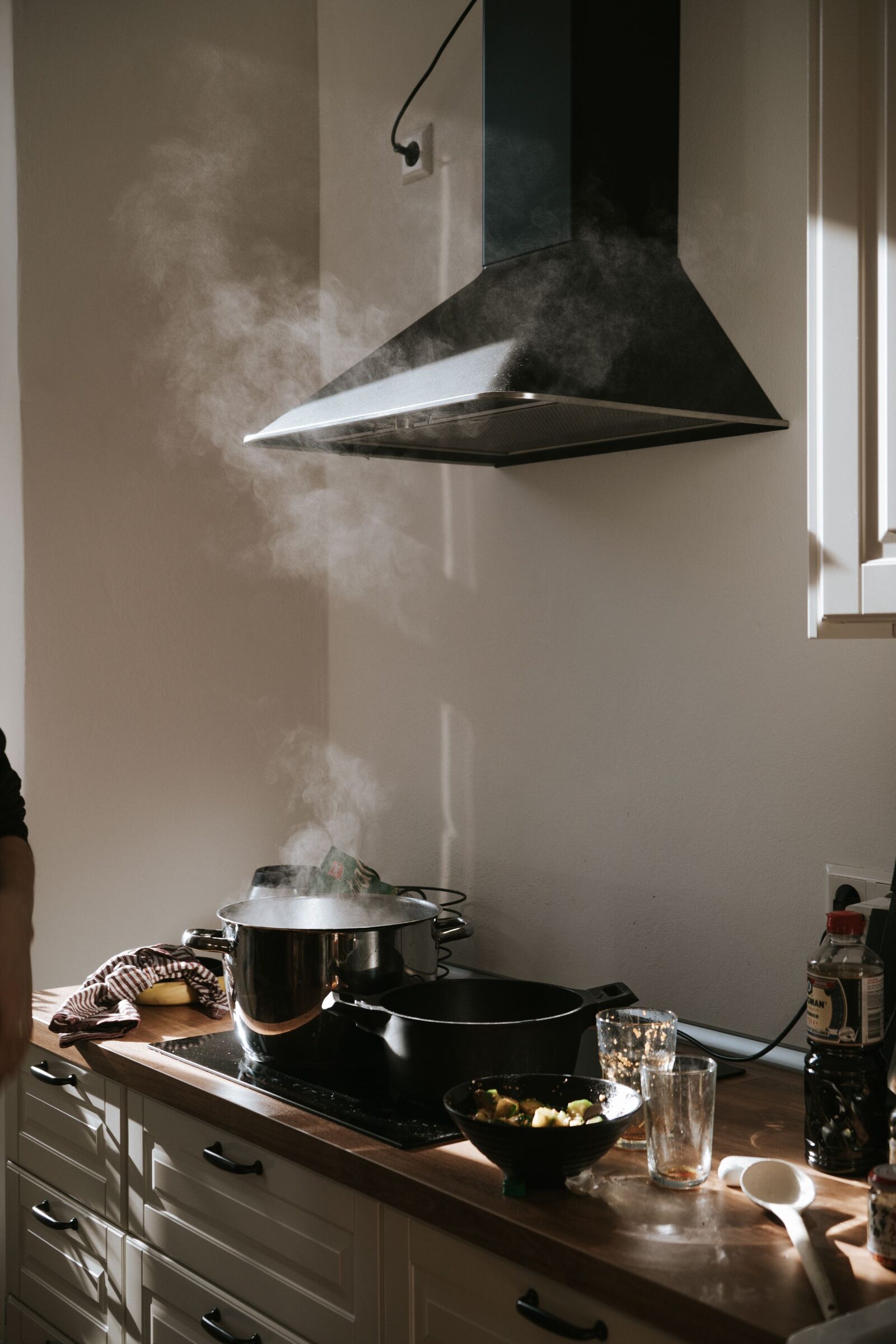
For kitchens, clause 10.8.2(2) names a “kitchen range hood” in its list, and the explanatory information to 10.8.2 states: “A range hood installed in a kitchen must comply with 10.8.2(2).” That is the outdoor-air discharge rule quoted above.
The 40 L/s figure in 10.8.2(1) is stated for an exhaust system installed in a kitchen. The explanatory information names subclause (2) for range hoods; how (1) is met in a particular kitchen is set in the design and confirmed by the relevant authority.
When does a bathroom fan need a light switch interlock and run-on timer?
Clause 10.8.2(4) applies to “An exhaust system that is not run continuously and is serving a bathroom or sanitary compartment that is not ventilated in accordance with 10.6.2(a)”. Such a system must “be interlocked with the room’s light switch” and “include a run-on timer so that the exhaust system continues to operate for 10 minutes after the light switch is turned off.”
Three conditions are in that wording: the room is a bathroom or sanitary compartment, it is not ventilated by openings under 10.6.2(a), and the exhaust does not run continuously. The clause does not apply the interlock and timer to kitchens or laundries.
What is make-up air, and when does a room need it?
Clause 10.8.2(5) states: “Except for rooms that are ventilated in accordance with 10.6.2(a), a room with an exhaust system in accordance with (1) must be provided with make-up air— via openings to an adjacent room with a free area of 14,000 mm²; or in accordance with AS 1668.2.” Clause 10.8.2(6) requires make-up air in accordance with AS 1668.2 for a room with a venting clothes dryer, with the same exception.
The explanatory information describes these as rooms “not naturally ventilated (e.g. rooms without openable windows)”, and gives an example of an opening with a free area of 14,000 mm²: “a 20 mm undercut to a 700 mm wide door.” AS 1668.2 is the Standard the clause calls up as the other route; this note does not describe its content.
Does an exhaust fan need a damper or seal?
Part 13.4 of the Housing Provisions, on building sealing, applies to a Class 1 building and to a Class 10a building with a conditioned space, with listed exceptions. Clause 13.4.5 states: “An exhaust fan must be fitted with a sealing device such as a self-closing damper, filter or the like when serving— a conditioned space; or a habitable room in climate zones 4, 5, 6, 7 and 8.” Its explanatory information adds: “An exhaust fan is considered to be adequately sealed if it is fitted with a filter such as the type commonly used in kitchen range hoods.”
For Volume Two, the glossary defines a conditioned space as “a space within a building that is heated or cooled by the building’s domestic services”, with an exclusion for some small heaters in non-habitable rooms. The explanatory information to 13.4.6 lists exhaust fans among the penetrations to be sealed. This note does not state a climate zone for any South Australian location.
Does South Australia change the exhaust rules, and who decides?
In Volume Two, H4D7(2) states that “Compliance with Part 10.6 of the ABCB Housing Provisions satisfies Performance Requirement H4P5 for ventilation”, and H4D9 states that “Compliance with Part 10.8 of the ABCB Housing Provisions satisfies Performance Requirement H4P7 for condensation management.” H4D7(1) adds that, “Except for an exhaust fan from a sanitary compartment, laundry, kitchen or bathroom”, H4P5 is satisfied for a mechanical ventilation system installed in accordance with AS 1668.2. These are Deemed-to-Satisfy routes; a Performance Solution is the other, and H4V3 is a verification method for indoor air quality in a Class 1 building.
Both South Australian schedules were checked. The Housing Provisions schedule lists variations to Parts 4.2, 9.2, 10.2 and 13.1 (SA 13.1.2 changes how Section 13 applies and does not alter clause 13.4.5), so Parts 10.6 and 10.8 are not varied. The Volume Two schedule’s Part H4 page contains only SA H4P1(2), on wet-area floors.
Whether a design meets the Deemed-to-Satisfy Provisions, or relies on a Performance Solution, and which NCC edition applies, is for the relevant authority assessing the building work to confirm.
Common Questions
Does a bathroom need an exhaust fan under the NCC?
Clause 10.6.2 of the NCC 2022 Housing Provisions, a Deemed-to-Satisfy provision, requires a bathroom to be ventilated, and an exhaust fan is one of the means it lists, alongside natural ventilation meeting the area and opening-location conditions in 10.6.2(a) and borrowed ventilation through an adjoining room meeting 10.6.2(b) — one of those conditions being that “the room to be ventilated or the adjoining room is not a sanitary compartment”, which Schedule 1 defines as “A room or space containing a closet pan or urinal”. Where an exhaust fan is used, its exhaust must comply with clause 10.8.2. Which means a particular bathroom relies on is a design decision assessed by the relevant authority assessing the building work, and a Performance Solution is another route.
What are the NCC flow rates for bathroom and laundry exhaust fans?
Clause 10.8.2(1) of the NCC 2022 Housing Provisions, a Deemed-to-Satisfy provision, states that an exhaust system installed in a kitchen, bathroom, sanitary compartment or laundry must have a minimum flow rate of 25 L/s for a bathroom or sanitary compartment and 40 L/s for a kitchen or laundry. A Performance Solution is the other route.
Where should a bathroom exhaust fan vent?
Clause 10.8.2(2) of the NCC 2022 Housing Provisions states that exhaust from a kitchen, kitchen range hood, bathroom, sanitary compartment or laundry “must discharge directly or via a shaft or duct to outdoor air”, and the Housing Provisions glossary defines outdoor air as “Air outside the building.” Whether a particular discharge point meets it is confirmed by the relevant authority assessing the building work.
When does a bathroom exhaust fan need a run-on timer?
Under clause 10.8.2(4) of the NCC 2022 Housing Provisions, an exhaust system that is not run continuously and serves a bathroom or sanitary compartment not ventilated by openings under 10.6.2(a) must be interlocked with the room’s light switch and include a run-on timer so that it “continues to operate for 10 minutes after the light switch is turned off.”
Does a kitchen range hood have to vent outside in Australia?
The explanatory information to clause 10.8.2 of the NCC 2022 Housing Provisions states: “A range hood installed in a kitchen must comply with 10.8.2(2).” Clause 10.8.2(2) requires exhaust from a kitchen range hood to “discharge directly or via a shaft or duct to outdoor air.” This is a Deemed-to-Satisfy provision; a Performance Solution is the other route.
Does a laundry need an exhaust fan?
Clause 10.6.2 of the NCC 2022 Housing Provisions requires a laundry to be ventilated, by natural ventilation meeting the area and opening-location conditions in 10.6.2(a), borrowed ventilation meeting 10.6.2(b), or mechanical ventilation under 10.6.2(c), with contaminated-air exhaust complying with 10.8.2. Where an exhaust system is installed, 10.8.2(1) sets a minimum of 40 L/s, and a venting clothes dryer must discharge to outdoor air under 10.8.2(3).
Sources
- NCC 2022, ABCB Housing Provisions — Part 10.6 Ventilation (clauses 10.6.1 to 10.6.3)Accessed 2026-11-16
- NCC 2022, ABCB Housing Provisions — Part 10.8 Condensation management (clause 10.8.2 and explanatory information)Accessed 2026-11-16
- NCC 2022, ABCB Housing Provisions — Part 13.4 Building sealing (clauses 13.4.1, 13.4.5, 13.4.6)Accessed 2026-11-16
- NCC 2022, ABCB Housing Provisions — Schedule 1 Definitions, Glossary (outdoor air, sanitary compartment, habitable room, conditioned space)Accessed 2026-11-16
- NCC 2022 Volume Two — Part H4 Health and amenity (H4P5, H4P7, H4V3, H4D1, H4D7, H4D9)Accessed 2026-11-16
- NCC 2022, ABCB Housing Provisions — Schedule 8 South Australia (index of variations)Accessed 2026-11-16
- NCC 2022, ABCB Housing Provisions — Schedule 8 South Australia, Part 13.1 (SA 13.1.2)Accessed 2026-11-16
- NCC 2022 Volume Two — Schedule 8 South Australia, Part H4 Health and amenity (SA H4P1)Accessed 2026-11-16
- ABCB — NCC 2025 state and territory adoption informationAccessed 2026-11-16
This page describes these sources as they stood on the access dates above. It is not legal advice about any particular property.
Planning a rebuild or new build in Adelaide? Start with a free initial consultation.