
Before a footing or slab for a house can be designed, the ground it sits on has to be given a class. For clay sites, the class indicates how much ground movement from moisture changes the site can experience. This note sets out what the National Construction Code says about that classification, quoted from NCC 2022. NCC 2025 was published on 1 May 2026, and the Australian Building Codes Board lists 1 May 2027 as the date its building provisions take effect in South Australia; which edition applies to a particular application is for the relevant authority. This note does not say what class any particular suburb or block falls into. That is established for the block itself.
What the NCC requires
Clause 4.2.2 of the ABCB Housing Provisions (NCC 2022) is one sentence: "The foundations where footings and slabs are to be located must be classified in accordance with AS 2870." South Australia’s variations to Part 4.2 of the Housing Provisions (Schedule 8) replace two other clauses in the Part and do not vary 4.2.2.
The explanatory information attached to the clause describes its own table as "a general description of foundation soil types that will assist in the classification of a site", and says that more detailed information, "including differentiation between classifications, can be found in AS 2870 or alternatively contact the appropriate authority". The table explains the classes; the classification itself is made under the Standard.
The classes, as the explanatory table describes them
Explanatory Table 4.2.2 gives these general definitions. Class A: "Most sand and rock sites with little or no ground movement from moisture changes". Class S: "Slightly reactive clay sites with only slight ground movement from moisture changes". Class M: "Moderately reactive clay or silt sites which can experience moderate ground movement from moisture changes". Class H: "Highly reactive clay sites which can experience high ground movement from moisture changes". Class E: "Extremely reactive clay sites which can experience extreme ground movement from moisture changes".
Two further entries sit outside that scale. Filled sites are listed as "A to P", with the note "see AS 2870". Class P covers "sites which include soft soils, such as soft clay or silt or loose sands; landslip; mine subsidence; collapsing soils; soils subject to erosion; reactive sites subject to abnormal moisture conditions or sites which cannot be classified otherwise."
"Reactive" in these definitions refers to the behaviour the table names: clay that moves as its moisture content changes. For Classes A to E, the letter describes how much ground movement a footing on that site has to accommodate.
Class M, and what M-D means
The notes to Table 4.2.2 add a subdivision that the single letters do not show. "For Class M, further division based on the depth of expected movement is required." The next note reads: "For deep-seated movement, characteristic of dry climates and corresponding to a design depth of suction change Hs, equal to or greater than 3 m, the classification must be M-D."
The consequence is stated in the third note: "If classification M-D is established due to further division, design of footings and slabs is beyond the scope of the ABCB Housing Provisions and reference must be made to AS 2870 for design and construction information." Whether a given site is M or M-D is part of its classification, not something that can be read from the letter M alone.
Where the Housing Provisions stop
Clause 4.2.1 states that Part 4.2 "is subject to the limitations set out in H1D4(2)". H1D4 sits in NCC Volume Two. Its subclause (1) lists the routes by which footings and slabs satisfy the structural Performance Requirement: AS 2870, AS 3600, or "subject to (2), Section 4 of the ABCB Housing Provisions". Subclause (2) then says that Section 4 "may only be used where" a list of conditions is met. The first is that "the footing is on a Class A, S or M site (classified in accordance with AS 2870) with a uniform bearing capacity".
The footing tables inside Part 4.2 follow the same line. Clause 4.2.14 covers "Stiffened rafts Class A, S and M sites" and clause 4.2.15 covers "Strip footings Class A, S and M sites". The explanatory information to 4.2.2 puts the other side plainly: "if a site is classified H, E or P then reference must be made to AS 2870 for design and construction information."
None of this says a house cannot be built on an H, E or P site. It says the Housing Provisions’ tables are not the design route for one, and points to AS 2870 instead.
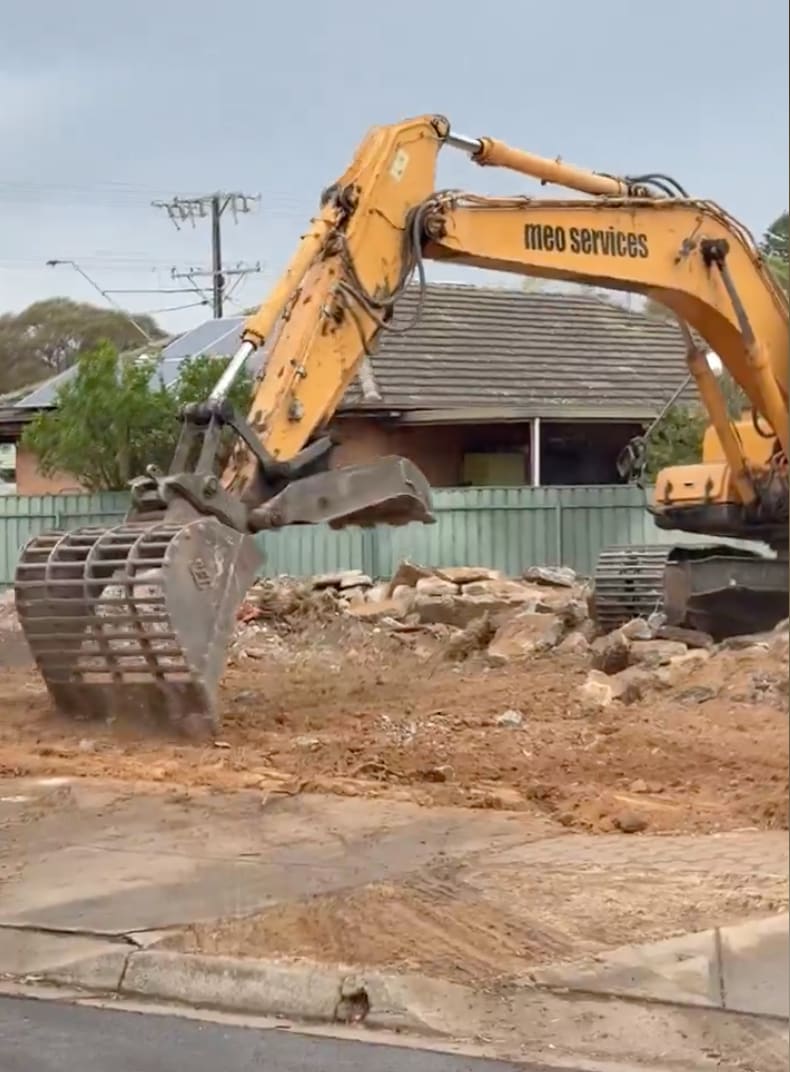
A block that has already carried a house
Under Volume Two clause H1D3(1), earthworks in accordance with Part 3.2 of the Housing Provisions satisfy Performance Requirement H1P1 "provided that the site is classified as A, S, M, H or E in accordance with 4.2.2 of the ABCB Housing Provisions and the work is undertaken in normal site conditions." Among the conditions in H1D4(2) is that "the site is considered to be normal as defined in Part 3.2 of the ABCB Housing Provisions".
The explanatory information to H1D3 lists parameters that "normal" site conditions relate to. Two of them are "the site conditions not being significantly modified by the removal of previous buildings or other structures", and "large trees have not been recently removed from the site in the area where the building is to be constructed". It adds that "further information regarding normal and abnormal site conditions can be found in AS 2870."
The NCC text does not say whether any particular demolition has "significantly modified" a site, and this note does not answer that for any block.
Common Questions
What site class is Adelaide?
A site class is given to a block, not to a city or a suburb. Clause 4.2.2 of the Housing Provisions requires the foundations where the footings and slab will sit to be classified in accordance with AS 2870. A neighbouring block’s classification is information about that block.
What is the difference between Class M and M-D?
The notes to explanatory Table 4.2.2 require Class M sites to be divided further by the depth of expected movement. Where the design depth of suction change is 3 m or more, the classification must be M-D, and footing and slab design then falls outside the Housing Provisions and is referred to AS 2870.
Can a house be built on a Class H, E or P site?
The Housing Provisions’ footing tables are not the design route for those sites. The explanatory information to clause 4.2.2 says that for sites classified H, E or P "reference must be made to AS 2870 for design and construction information", and H1D4(2) limits the Housing Provisions’ own footing route to Class A, S or M sites.
Does demolishing the old house change the classification?
The explanatory information to H1D3 lists, among the parameters of "normal" site conditions, the site not being significantly modified by the removal of previous buildings, and large trees not having been recently removed where the building will go. The NCC text does not decide whether that applies to a particular block, and this note does not; the explanatory information refers to AS 2870 for further information on normal and abnormal site conditions.
Is the explanatory table itself a requirement?
No. Table 4.2.2 is headed "(explanatory)" and the NCC describes it as a general description to assist classification. The requirement is the sentence in 4.2.2 itself: classification in accordance with AS 2870.
Sources
- NCC 2022, ABCB Housing Provisions — Part 4.2 Footings, slabs and associated elements (clauses 4.2.1, 4.2.2 and explanatory Table 4.2.2, 4.2.14, 4.2.15)Accessed 2026-09-28
- NCC 2022, Volume Two — Part H1 Structure (clauses H1D3 and H1D4, with explanatory information)Accessed 2026-09-28
- NCC 2022, ABCB Housing Provisions — Schedule 8 South Australia variations (Part 4.2)Accessed 2026-09-28
- ABCB — NCC 2025 state and territory adoption informationAccessed 2026-09-28
This page describes legislation as it stood on the access dates above. It is not legal advice about any particular property.
Planning a rebuild or new build in Adelaide? Start with a free initial consultation.